
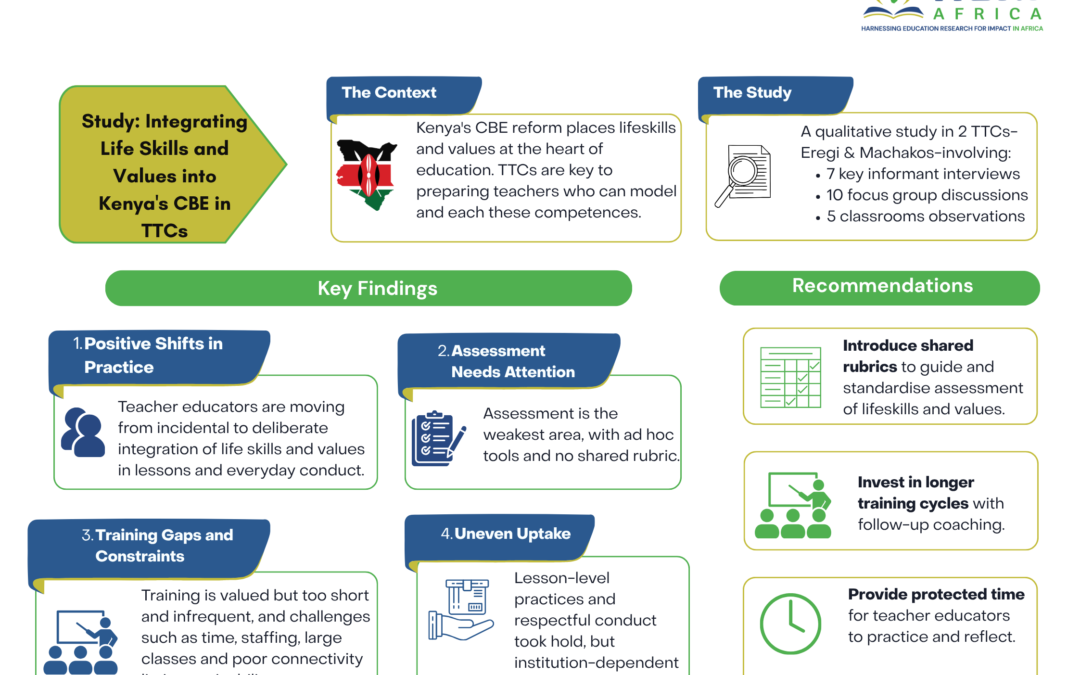
Kenya’s new Competency-Based Education (CBE) curriculum aims to equip learners with knowledge, skills, values and life skills they can use in daily life. For this to happen, teacher trainees must be adequately prepared in their colleges before they join learners in schools.
To show the benefits of this approach, a new study on how teacher educators in Kenya are doing this in teacher training colleges has been published. It covers what is working, what can be improved, and what support is needed to make teaching life skills and values practical.
Read the full paper here: https://doi.org/10.1080/03055698.2026.2751072
The study, “Integrating life skills and values into Kenya’s Competency-Based Education (CBE) in Teacher Training Colleges (TTCs)”, was published in Educational Studies. It focuses on Eregi and Machakos Teacher Training Colleges as the basis of the research. The authors are Jackline Nyerere , Paul Nyangau and John Kabutha Mugo. Prof Nyerere is HERI Africa’s Research Chair in Life Skills and Values Education at Kenyatta University, with Dr Mugo being her co-chair, and also Executive Director of Mizizi Elimu Afrika. Paul Nyangau is a research fellow at the university.
The study comes as Kenya’s Competency-Based Education (CBE) reform places life skills and values at the centre of holistic learning. This work reflects HERI Africa’s broader commitment to strengthening African-led education research and ensuring evidence informs policy and practice. Through its Research Chair in Life Skills and Values Education at Kenyatta University, HERI Africa is supporting the strengthening of research capacity and the building of evidence on how life skills and values can be integrated across education levels.
In the study, the researchers asked how teacher educators and trainees understand and practise life skills and values, how these are assessed, and what conditions at the colleges affect them. The colleges were taking part in the Action for Life Skills and Values in East Africa (ALiVE) initiative.
What the study found
Teacher educators are building communication, collaboration, problem-solving, and digital literacy into lesson plans, group work, presentations, practical assignments, and peer teaching. They also teach values like respect and responsibility through daily interactions and by setting examples.
Learning also happens outside the classroom, including clubs, games, sports, practical activities and the daily routines of college life, all of which give trainees a chance to practise.
What colleges and education leaders can do
- Make assessment simpler and more consistent by using practical examples.
- Keep training going through follow-up coaching, refresher sessions, and learning from peers.
- Set aside time to practise through micro-teaching, reflection, peer observation, and hands-on learning in the timetable.
- Involving college management and its departments.
Why this matters
The study shows that change depends on how learning is assessed, what training teachers get, and how training in college is led. This is useful for policymakers, teacher training institutions, and education partners in deciding how to improve teacher preparation and support learning in schools.