

HERI AFRICA FIELD NOTES
Inside a week of supportive monitoring visits to Mathematics Club schools across Embu, Meru, Kirinyaga, and Tharaka Nithi counties.
Written by Gladys Siamanda, HERI Africa Planning, Monitoring, Evaluation and Learning (PMEL) Coordinator
Prof Ciriaka Gitonga, HERI Africa Research Chairs Coordinator, and I left Nairobi at 6:00 in the morning, chasing the sunrise toward Embu; to join Dr Simon Karuku, HERI Africa Research Co-Chair in Mathematics Education and team for a week monitoring across four counties that would remind all of us why this work matters.
University of Embu’s teams visited 27 schools across Embu, Meru, Kirinyaga and Tharaka Nithi under the Mathematics Research Chair program. I spent my week in Tharaka Nithi with Prof Ciriaka and Victor Saoke, HERI Africa’s Project Officer, while colleagues covered Embu, Kirinyaga, and Meru in parallel. This was not an inspection exercise. It was a conversation, school by school, with the class teachers, headteachers and Mathematics Club facilitators (University of Embu’s Bachelor of Education students) who are making numeracy click for thousands of learners.
IN THE CLASSROOM
Getting our hands into the lesson
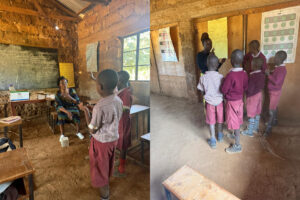
Prof Ciriaka and Gladys Siamanda engaging learners with a Mathematics activity
Prof Ciriaka, Saoke and I joined the learners for the Mathematics club activities led by the facilitators, counting cubes, working through place value, and yes, a fair bit of laughter along the way. A few classrooms over and young enthusiastic facilitators walking their class groups through Mathematics clubs’ activities. Small rooms, big ideas.
FACILITATORS IN ACTION
The young enthusiastic facilitators making it all happen
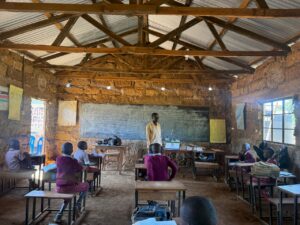
A Mathematics club facilitator leading a lesson in a classroom
Every club runs on the energy of a facilitator standing in front of the room. Here, a facilitator holds the attention of a full classroom, chalk in hand, mid lesson, doing the quiet, unglamorous work that is changing how these learners see Mathematics.
TOOLS OF THE TRADE
What it actually takes to make numbers fun
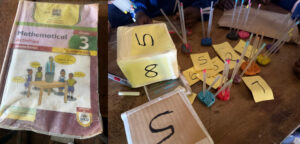
Grade 3 Mathematical activities learner book & number cards made from modelling clay and straws
A Grade 3 learner’s book sits on a learner’s desk: number stands made from modelling clay, drinking straws and hand labelled cards. This is what resourcefulness looks like when materials are scarce and imagination is not.
LISTENING CLOSELY
The conversations that matter most
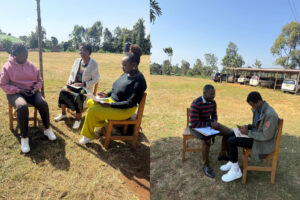
Left: Interviewing a class teacher under a tree. Right: Victor Saoke interviewing a Mathematics club facilitator
Some of the most honest feedback of the week came sitting under a tree, notebook in hand, interviewing class teachers about what has changed since the club began, and what they still need to keep it going. Elsewhere on the grounds, Saoke, HERI Africa’s University of Embu Project Officer, sat down with one of the Mathematics Club facilitators to hear directly from the students shaping this program from the front of the classroom.
FULL CIRCLE
Back to where the facilitators come from

University of Embu
Every facilitator we met in these schools connect to University of Embu, home to the Mathematics Research Chair and the pre-service teachers who are giving up their time to make Mathematics a little less scary and a lot more fun for young learners.
REFUEL
And then, lunch, on Prof Ciriaka
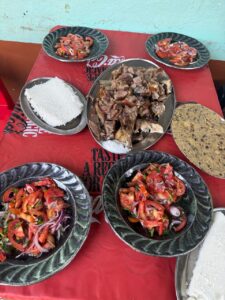
Lunch treat at a nyama choma joint
Every good field trip runs on good food. Prof Ciriaka treated the team to lunch at a popular nyama joint at Hilltop, Mitheru, tomato kachumbari, ugali, roast meat and all. A fitting way to close out a day full of classrooms, conversations and chalk dust.
BY THE NUMBERS
What a week on the road adds up to
27Schools visited across the week |
4Counties covered: Embu, Meru, Kirinyaga, and Tharaka Nithi |
MEAN SCORE MOVEMENT, REPORTED THIS TERM
School A68 -> 72Before Now+4 points |
School B47.5 -> 62.5Before Now+15 points |
What’s emerging across the four counties
Beyond the numbers, five patterns kept showing up, school after school, county after county.
|
Confidence is contagious Learners who once avoided Mathematics are now volunteering to work sums on the chalkboard, and in more than one school, practically racing each other to get there first. |
|
Play is doing the heavy lifting Counting games, movement activities and simple concrete objects like counters, modelling clay and straws are pulling in even the most reluctant learners, and they keep playing the games during break time, long after the club session ends. |
|
The ripple is reaching class teachers Class teachers are adopting the club’s activity-based methods in their daily lessons, and other grades are now asking to be included too. |
|
Schools are planning ahead, together with us As HERI Africa explores handing more direct facilitation to class teachers next term, schools across all four counties gave candid, constructive feedback on what they will need to make that transition work. |
|
The needs are simple Almost everywhere we went, the ask was the same: more crayons, dice, counters and basic teaching aids. Some of the biggest gains in this program are being unlocked by very small, very affordable tools. |
Grade 3 learners and the logic of place value
As a Mathematician, my favourite moment of the week was watching a room full of Grade 3 learners grasp the logic of place values, confidently moving between tens, hundreds and thousands. It is a small thing to describe and an enormous thing to witness.
HERI Africa’s Research Chair at the University of Embu is preparing an August 2026 orientation workshop to prepare class teachers for a bigger role next term. Everything schools told us this week, about materials, about time, about training, will shape how that transition is built.
#Maths4Life 💪