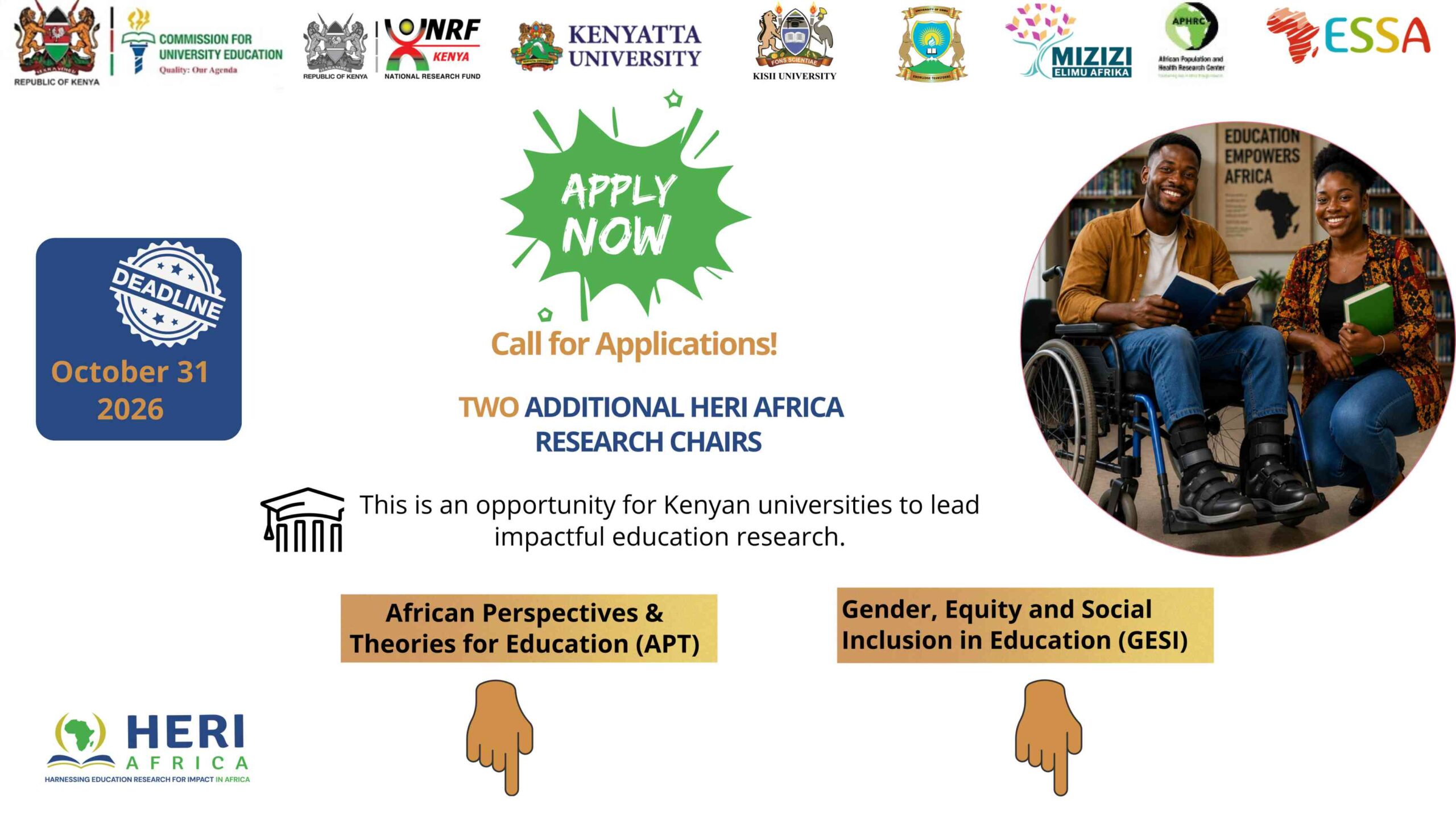
Strategic Pillars - Research Chairs
Strategic Pillars- Research Chairs Anchoring African-led research excellence to forge a new generation of high-impact, policy-informing education specialists.
Research Chairs are dedicated positions, inspired by the South African Research Chairs Initiative (SARChI) , that attract and retain leading researchers to focus primarily on innovative research and postgraduate supervision. They build a sustainable talent pipeline and generate robust evidence to inform policy and practice in key education priority areas
Why Research Chairs

Focused Research
Attracting and retaining leading and emerging researchers dedicated to advancing knowledge in priority education areas.
Building a Pipeline
Addressing Kenya’s current shortage of skilled education researchers and building a sustainable pipeline of education specialists.
Policy Relevance
Generating robust evidence to inform education policy and practice, particularly concerning system-wide reforms like the implementation of Competency-Based Education (CBE).
Inclusivity
Fostering inclusivity by supporting researchers and postgraduate students, including those from underrepresented communities.
Thematic Focus
Language
Education
Mathematics
Education
Life Skills and
Values Education
Gender in
Education
Indigenous African
Knowledge Perspectives
Implementation and Support of NRAP
Establishment and Research Activities
Establishment and Operationalization (Output 3.1): By 2026, five Research Chairs will be established and operationalized. The inaugural three chairs will be hosted by Kenyatta University, University of Embu, and Kisii University. A competitive and transparent recruitment process prioritizing excellence, meritocracy, and gender equity will be applied to install the Chair leaders. Research Activities (Output 3.3): Research activities will be initiated and implemented, led by the HERI Research Chairs and supported by postgraduate students and faculty at partner universities. Only research proposals aligned with national priorities will be admissible. Researchers will be supported in developing manuscripts for publication and disseminating findings.
Capacity Building and Mentorship
Postgraduate Support (Output 3.2): Comprehensive support will be provided to postgraduate students to build a pipeline of competent education researchers. The initiative aims to recruit and support 15 PhDs and 21 Masters students, with a proactive lens on encouraging women and underrepresented groups (50% women and 10% persons living with disabilities). Mentorship: Mentorship programs will be rolled out to strengthen research quality and capacity, and supervisors and mentors will be incentivized to ensure effective and timely guidance. Training Access: Research Chairs will access training via the Centre for Education Research and Innovation (CERI) and the Virtual Learning Academy (VLA), as well as opportunities for collaboration and mentorship.
Monitoring and Coordination
MEAL System (Output 3.4): A robust Monitoring, Evaluation, Accountability, and Learning (MEAL) system will be established and embedded across the five HERI-Africa Research Chairs within the first two months of the launch. This system will track progress, research outputs, utilization of research findings, and policy influence. Chair Coordination Office (Output 3.5): A Chair coordination office will be established at the University of Embu, led by Prof. Ciriaka Gitonga, to facilitate cross-Chair collaboration and learning.
Financial Support
University Financial Support (Output 3.6): The five universities hosting the Research Chairs will receive financial support of up to a maximum of 15% of the accounted direct expenses. This support is intended to meet the cost of shared administrative services (e.g., security, IT systems, and cleaning).